
Home › Coverages › Dental Office Property & Equipment Insurance
Property and equipment insurance for dental offices
Dental office property insurance pays to repair or replace your chairs, imaging, scanners, sterilization equipment and the build-out you paid for after a fire, theft, storm or other covered loss. Adding equipment breakdown extends it to the compressor, the autoclave or the CBCT unit that fails on its own.
- Since 2003
- 12+ A-rated carriers
- 28 states
- Independent agents
Start your dental practice insurance quote
Takes about two minutes. A licensed agent follows up.
Licensed in 28 states · NPN 7642818 · Since 2003
What dental office property insurance protects
Dental office property insurance covers the physical things the practice owns or is responsible for: equipment, furniture, supplies, computers and the improvements you paid for in the suite. If the practice or its owners own the building, that goes on the policy too. Most single-office practices buy it inside a business owner's policy; larger groups often carry it as a stand-alone commercial property policy.
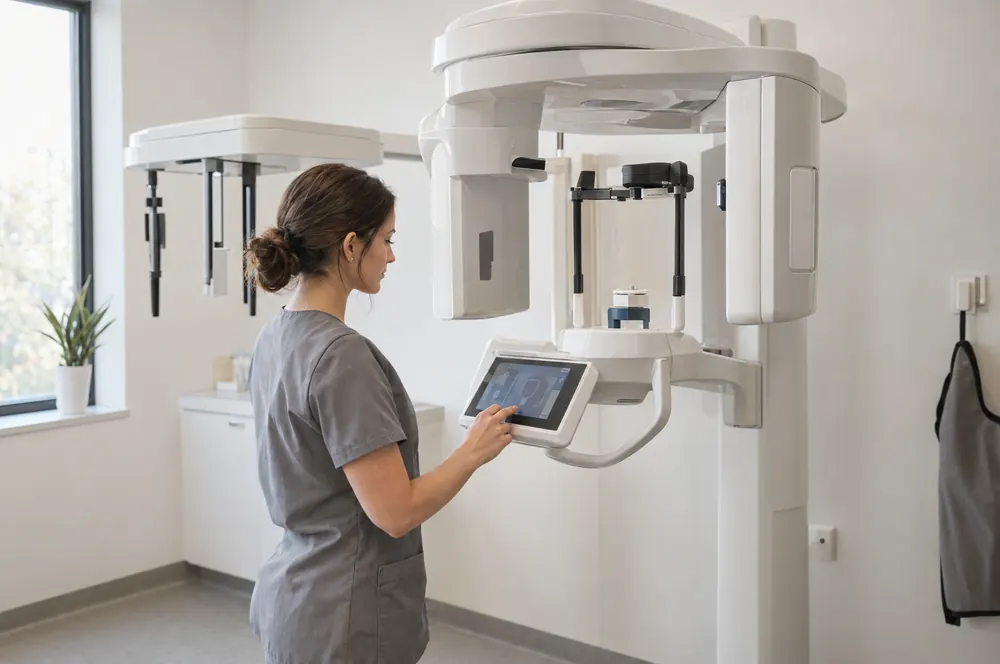
A dental office holds more equipment value per square foot than most small businesses. Published purchasing guides give a sense of scale:
- A CBCT unit: about $50,000 to $100,000 for a small-to-midsize unit, according to a 2020 purchasing guide published by the Academy of General Dentistry. Larger field-of-view units cost more.
- An intraoral scanner: commonly $15,000 to $50,000.
- The full equipment package for a new practice: anywhere from $25,000 to $400,000 in one published start-up guide, depending on the number of operatories and the services offered.
Add the sensors and panoramic unit, the autoclaves, the compressor and vacuum system, and the front-office network, and a modest practice can carry several hundred thousand dollars of equipment. These are planning figures, not quotes. The point is to insure at replacement cost and raise the limit after every major purchase.
Your build-out counts as well. Plumbing to every chair, cabinetry, shielded walls around imaging, compressed-air and vacuum lines, and upgraded electrical work become part of the landlord's building once installed. The standard business owner's form calls them tenant's improvements and betterments and insures them as part of your business personal property.
Dental equipment insurance: in and out
| What it usually covers | What it usually doesn't |
|---|---|
| Chairs, delivery units, lights and cabinetry after fire, smoke, theft, vandalism or water from a burst pipe | Mechanical or electrical breakdown, unless equipment breakdown is added |
| Imaging equipment, sensors, scanners and milling units at the office | Wear and tear, gradual deterioration and routine calibration or adjustment |
| Autoclaves, compressors, vacuum systems and the office's computers | Flood and earthquake, which usually need separate coverage |
| Tenant improvements and betterments you paid for | The landlord's building shell, which the landlord usually insures |
| Supplies and inventory, including small stocks of materials | Spoiled temperature-sensitive stock, unless spoilage is added |
| The building, if you own it | Data restoration beyond a small built-in amount |
How equipment and build-out claims play out
These stories are fiction, but they show the two claims that most often surprise a practice: a machine failing on its own, and damage to improvements the practice paid for.
Example scenario: a surge on a Thursday afternoon
An oral surgery and implant practice loses power for a few seconds when a transformer down the street fails. When the lights return, the CBCT unit won't start and an autoclave shows a control fault. Nothing burned, nothing was stolen, and no water got in.
On the standard property forms, damage from artificially generated electrical current is excluded unless a fire results. So the base policy usually doesn't pay for the control boards. Equipment breakdown coverage is built for this loss: it adds back direct damage from electrical failure and mechanical breakdown of covered equipment, subject to its own deductible.
Breakdown coverage still has limits. It doesn't pay for adjustment, alignment, calibration or cleaning, for leaks at valves and fittings, or for parts that simply wore out. Those stay maintenance costs.
Example scenario: a fire next door on a Saturday night
A general practice leases a suite in a strip center. On Saturday night a kitchen fire starts in the restaurant next door. By Sunday the shared wall is charred, and smoke and the fire crew's water have soaked the practice's cabinetry, flooring and the lead-lined walls around the panoramic room.
Under a typical lease, the landlord's policy rebuilds the shell of the building. The practice's own policy is expected to pay for the build-out it installed, the equipment and the supplies. Weeks of closure are a separate loss, which is what business income coverage is for.
The valuation rule for tenant improvements
What changes the price of dental property coverage
Property premiums follow the values you insure and the building they sit in. Underwriters usually look at:
- Total insured values. Equipment, supplies and improvements at replacement cost, plus the building if you own it.
- Construction and protection. Masonry or frame, the building's age, sprinklers, monitored alarms and the local fire department's rating.
- Location. Wind, hail and wildfire exposure change the rate, and some areas carry separate deductibles for those perils.
- Deductibles. A higher property deductible lowers the premium and raises what you pay on each claim.
- Equipment breakdown and other options, such as spoilage or higher data limits.
- Claims history at the office.
What the rest of your program costs depends on your building and equipment values, your revenue and payroll, how many locations and team members you have, the limits you choose and your claims history.
Equipment lenders and lessors often ask to be listed on the policy as loss payee, so a claim check for financed equipment also goes to them. Ask them for their exact wording before the equipment arrives.
Which practices need the closest look
Specialty practices often carry the most imaging per chair: CBCT units, surgical microscopes, implant motors and scanners. Insurance for specialty practices
Practices that just built out or bought in usually have new improvements on a lease and new equipment on a loan, and both lenders want replacement-cost limits. The insurance checklist for buying a practice
Dental labs run milling machines, sintering and porcelain furnaces and 3D printers, where breakdown coverage matters as much as fire coverage. Dental lab insurance
Spoilage is a minor line for most general practices, since only some medications and materials need refrigeration. It matters more for a lab, or for a practice that stores bone-graft and other temperature-sensitive materials.
State notes for dental office property
Property coverage follows the same forms in most states, but local hazards decide which exclusions matter.
Utah: the March 2020 Magna earthquake (magnitude 5.7) damaged buildings across the Salt Lake Valley, and a 2016 forecast by the Working Group on Utah Earthquake Probabilities gives the Wasatch Front a 57% probability of one or more quakes of magnitude 6.0 or greater within 50 years. Standard commercial property forms usually exclude earthquake, so ask how to add it. Utah
Nevada: Henderson's flood-control office warns that flash flooding is most likely in the July to September monsoon, when brief but intense thunderstorms send runoff into low-lying areas. Flood is usually excluded, so a ground-floor office should price flood options separately. Nevada
Texas: Hurricane Harvey dropped up to 56 inches of rain in the Houston and Galveston area in 2017. Chairs and imaging on a ground floor are exposed, and flood needs its own policy. Texas
Colorado and California: the 2021 Marshall Fire destroyed 550 residential structures in Louisville alone, and the 2025 Eaton Fire destroyed 9,419 structures around Altadena and Pasadena. Wildfire is generally a covered cause of loss, which makes current replacement values the main thing to check. Colorado · California
Related coverage
Property and equipment questions
Does my landlord's insurance cover my dental office build-out?
What is equipment breakdown insurance, and do dentists need it?
Replacement cost or actual cash value: which should a dental office pick for its equipment?
Is financed or leased dental equipment covered by my policy?
Does property insurance cover flood damage to my dental office?
Ready to see what you'd pay?
Independent agents, 12+ A-rated carriers, and a licensed agent back to you within one business day.